Imagine if we were required to use our meal points to go to the bathroom here at Villanova, and if we did not have enough points, we would not be able to go. This would be pretty annoying, as our meal plan are already complicated. Now imagine if everyone decided to revolt against Father Peter because of this policy. How would this end?
Well, this is pretty much the Villanova equivalent of “Urinetown.” Villanova Theater’s production is sure to surprise audiences large and small, provoking audience-wide reactions (if you saw the show, you know) and gasps throughout the entire musical. “Urinetown” is considered a shorter musical, with an entertaining 1 hour and 55 minutes of run time. The cast got interactive with the audience before the show. I had a particularly humorous interaction with Officer Barrell before the show, during which she interrogated my friends and me about whether we had tickets.
“Urinetown” is the 2002 Tony Award Winner for Best Original Score. This satirical musical delivers bold humor by taking shots at capitalism and referencing other popular Broadway musicals. The clever puns and songs make for a comedic critique of society manifested into an energetic, spirited musical. “Urinetown” combines social commentary with Broadway showmanship to give the audience a little bit of everything: a love story, dark humor and compelling characters.
“Urinetown” takes place in a dystopian city stricken by a drought. Private toilets have been outlawed, and it is expensive to use the legal public amenities. The entire show is narrated by Little Sally, a sweet young girl who often questions the morals of fellow narrator, Officer Lockstock. He has a soft spot for Sally and is the only character who offers her a “penny for a pee” when she asks. Caldwell B. Cladwell, head of “Urine Good Company,” controls the public amenities, profiting off of one of society’s most basic needs. When Joseph “Old Man” Strong decides he has had enough with the oppression and illegally uses the bathroom in public, he is sent to ‘Urinetown.” His son, protagonist Bobby Strong, then decides to lead a revolution against the cruel tyrants of Urine Good Company. In the meantime, Bobby falls in love with Hope Cladwell, Caldwell B. Cladwell’s daughter, who eventually becomes a revolutionary herself. All the while, the question looms over the audience’s head: Where, or what, is “Urinetown?”
Leading actor David Walker owned the stage as Bobby Strong and displayed his enormous vocal talent while performing songs like “Run Freedom Run” and “Look at the Sky.” Compared to the completely silent role Walker played in “Arcadia,” watching his very vocal character in “Urinetown” come to life was truly incredible. His versatility is impressive, and his mighty voice ringing through the theater provoked cheers at the end of every run.
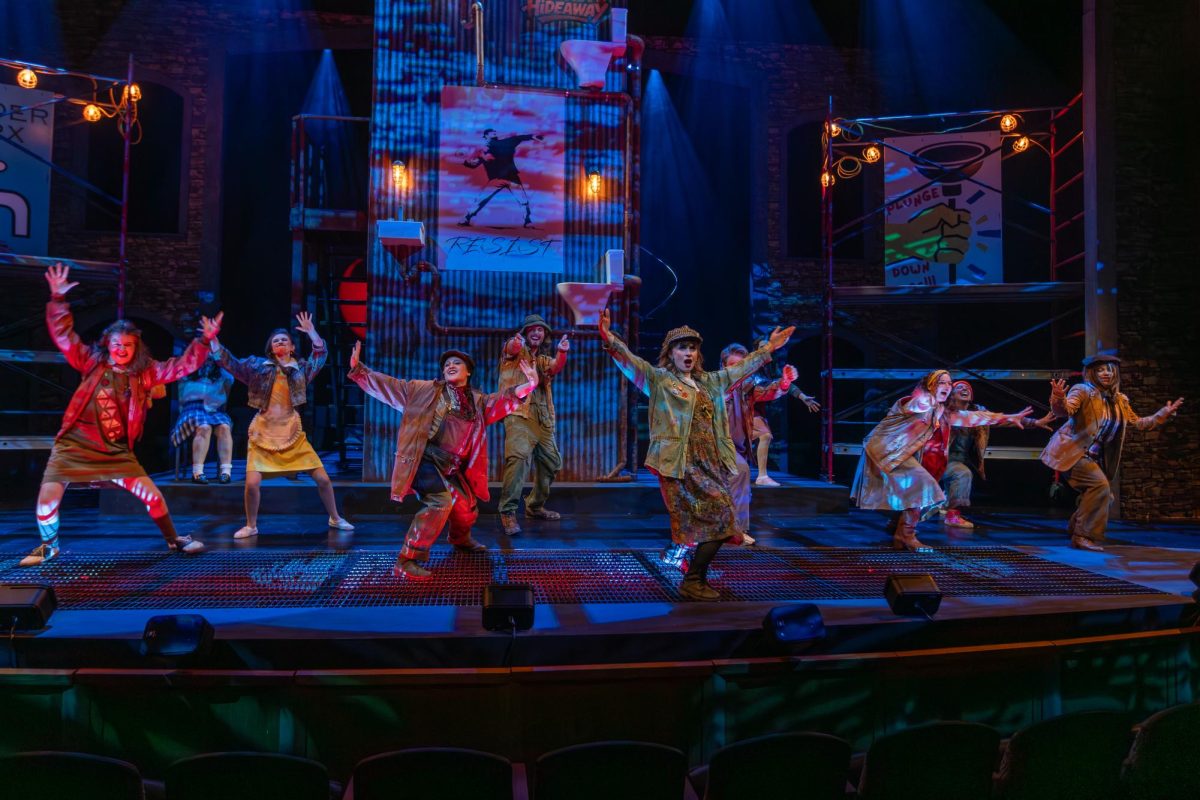
In terms of the set, “Urinetown” has a unique, two-story turntable design. Turn tables are used in many other popular Broadway shows, such as “Hadestown” and “Hamilton: An American Musical.” This turntable allowed the set to have four sides, making for four different settings. Imagine the set as a rotating rectangle: there are two larger sides and then two skinnier, smaller sides. The first large side was Public Amenity #9, which is where most of the scenes took place. The opposite side of Public Amenity #9 is Caldwell B. Cladwell’s office, in blue and yellow hues for a bright contrast to the other locations. The last two smaller sides served as the backdrops for the revolutionaries’ secret hideaway and a dark alley.
In theatre, everything is intentional. Actors pressed plungers onto the turntable and made it look as if they were turning the set around. Whenever an actor removed their plunger, a satisfying ‘pop’ noise rang through the Topper Theatre.
“This detail was to show how the characters drive the story of ‘Urinetown,’” set designer Paris Bradley said. “It was all intentional, and we knew that the audience would like the suction noises when the actors lifted the plungers, too.”
Villanova Theatre’s production exceeded expectations. The intense rehearsal process paid off in cheers from the audience, laughs from those who understood the niche references and flowers from loved ones.
Penelope Pennywise, played by Abigale Townsend, sang, “It is a privilege to pee.” This show was certainly a privilege to see.