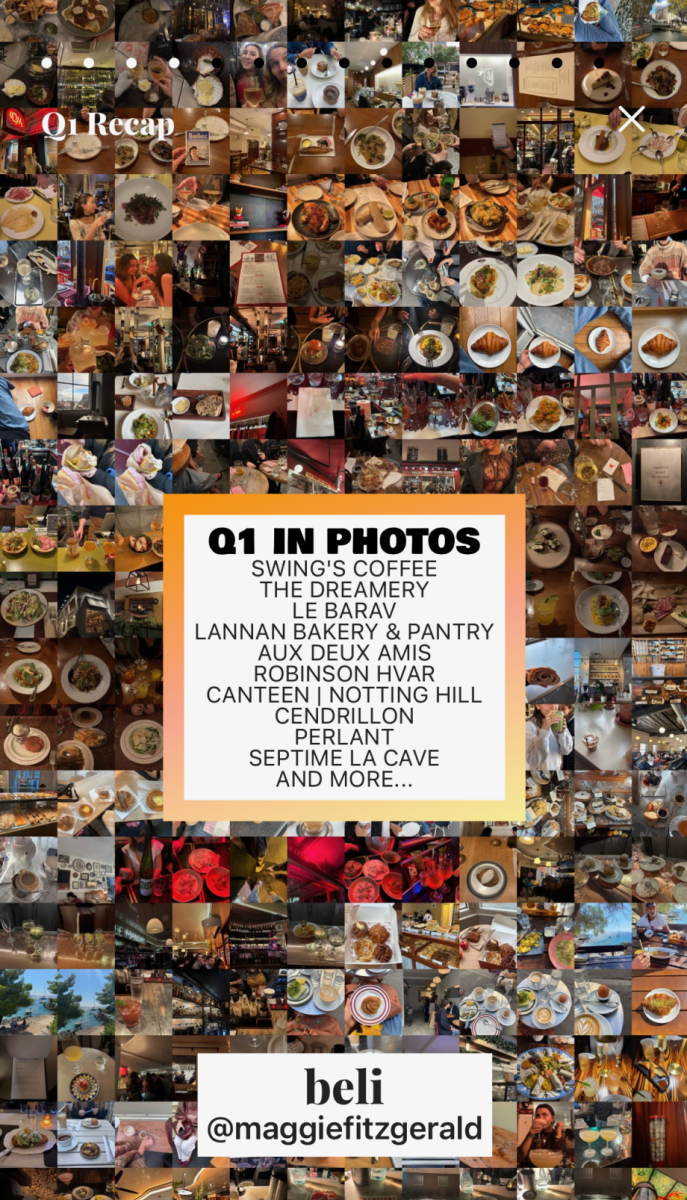

Be honest. You’ve watched one. Maybe it started with a yogurt bowl with frozen berries and organic granola, iced coffees in fancy glassware and ended with supplements and a “sweet treat.” Open TikTok or Instagram on any given afternoon, and it won’t take long before a “What I Eat in a Day” video appears.
This genre has become its own digital ritual. Scroll long enough, and you will find dozens of them. Gym girl editions, college apartment meals, “high protein,” “intuitive eating” and other buzzwords cycle through the algorithm. What looks like harmless inspiration quickly becomes a quiet blueprint for how we think we should be eating.
At Villanova’s recent “Facts vs. Fears: Social Media, Food and Body Image” event held this past Thursday in the Health and Services Building, students were asked to reconsider this online fad. An unsettling question arose: when did scrolling turn into self-evaluation?
Senior Samantha Grubb, who led part of the presentation, shared findings from a survey of 215 Villanova students that revealed the pervasiveness of these health trends.
“When I looked at the quality of responses, it became clear that social media isn’t just a distraction anymore, but more functioning as a guide to how we’re self-improving ourselves,” Grubb said. “Students described using social media as their source for learning how to structure their workouts, what to eat and how to treat their bodies overall.”
In other words, digital platforms have quickly become a wellness syllabus. Sixty-five percent of respondents reported seeing health-related content often or very often. Even more striking was that 86% had interacted with it in the past month. Students were not simply scrolling past these videos. They were engaging with them, sharing them, saving them and returning for more.
The influence does not stop at the screen. Seventy-eight percent of surveyed students incorporated a health change due to something they saw online. While some changes seem small, the cumulative effect can be significant.
“It puts a lot of pressure seeing other people’s daily diet,” sophomore Samantha DiMento said. “It causes people to overthink their own eating habits and routines when other people are in their face all the time.”
Jessica Pellicciotta, coordinator of Nutrition and Fitness Programs, explained why these videos can be harmful to students’ health knowledge.
“They’re very curated,” Pellicciotti said. “They’re appealing, most of the time they are showcasing this perfect eating pattern, which is so unrealistic and unattainable, especially for college students.”
Pellicciotti emphasized that nutrition is highly individualized and depends on a range of personal factors, including schedule, medical history and goals. She warned that many influencers lack professional credentials and accountability. Without oversight, viral advice can promote restrictive eating patterns and false expectations that do not support long-term well-being. She also noted that much of the available health research has historically been conducted on men, making it even more complicated to generalize advice across different bodies.
The pressure is not always obvious. Sometimes it looks like fascination.
“I’m obsessed with watching ‘What I Eat in a Day’ videos,” sophomore Alessandra Fioretti said. “It’s so interesting, but it’s definitely bad sometimes because it’s all you think about.”
These videos seem motivating and inspiring, yet they can distort students’ perception of what being healthy is.
The event stressed that the issue is not curiosity. It is comparison. When meticulously planned routines and arranged meals fill a feed, it becomes easy to measure one’s own day against someone else’s highlight reel. Behind every neatly edited clip is selectivity. What is shown is intentional. Viewers do not see what is left out, and as a result, may not realize that nutrition and fulfillment are not one-size-fits-all.
The takeaway from this event was not to delete social media, but to scroll with awareness. To ask who is providing the advice and why. To remember that health cannot be condensed into a 30-second montage. Health is personal and far more complex than what fits on a screen.