
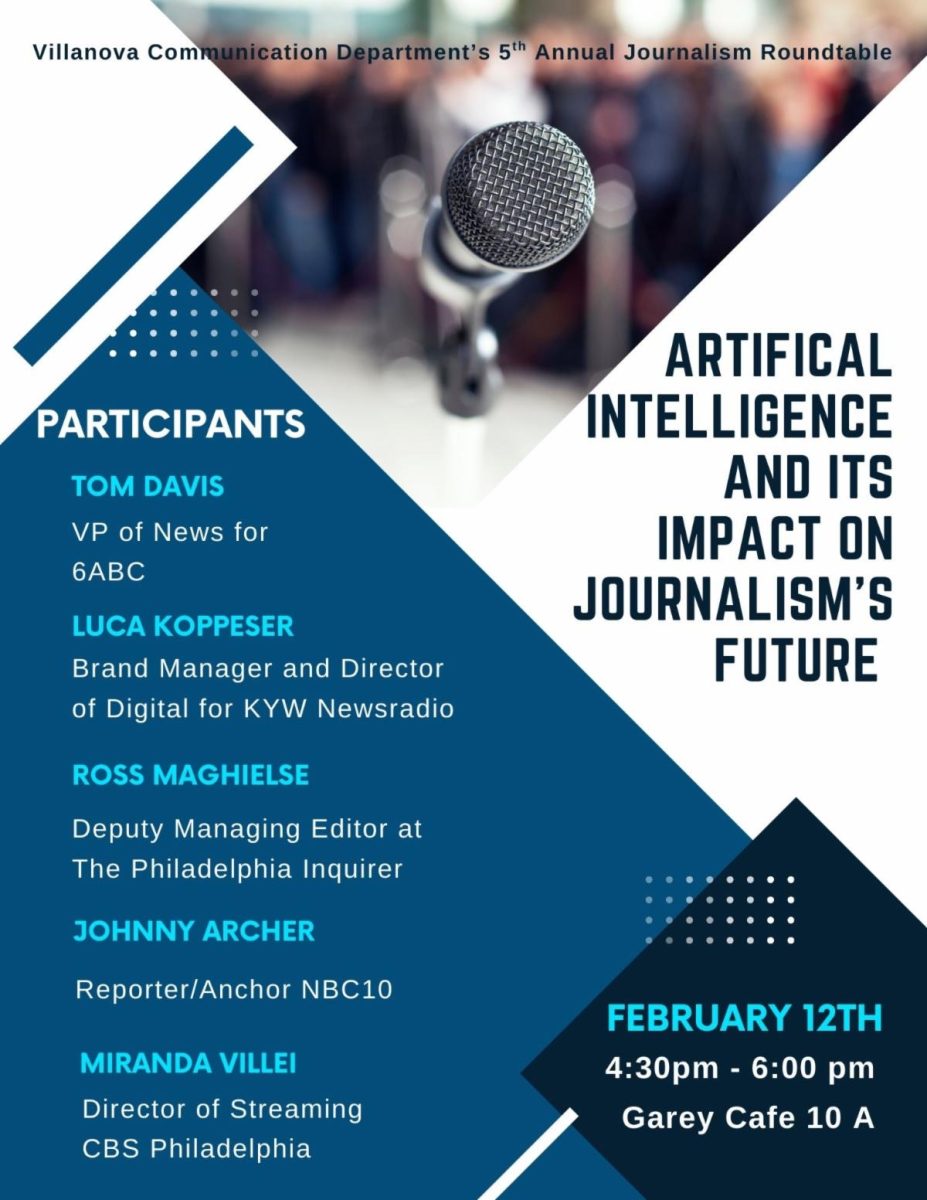
On Feb. 12, the Communication Department will host its fifth annual Journalism Roundtable. This year’s topic is “Artificial Intelligence and its Impact on Journalism’s Future,” a highly debated issue that has gained significant traction since last year’s discussion.
The roundtable will take place from 4:30-6:00 p.m. in Garey Hall Room 10A. It will be moderated by Communication Department professor Michael Bradley and will feature insights from five panelists, each with experience in a specific medium.
Bradley first chooses a topic for the roundtable, aiming to make the conversation both relevant and entertaining. Then he selects panelists who would offer diverse perspectives during the discussion.
“The reason I try to pick such a diverse group is that I want everybody to have someone that they are maybe identifying with,” Bradley said.
The panelists joining the discussion are Tom Davis, Vice President of News for 6ABC; Luca Koppeser, the Brand Manager and Director of Digital for KYW Newsradio; Ross Maghielse, Deputy Managing Editor at The Philadelphia Inquirer; Johnny Archer, Reporter/Anchor for NBC10; and Miranda Villei, Director of Streaming at CBS Philadelphia.
“I want to make sure there are women and men,” Bradley said. “I want to make sure there are people of color. I want to make sure there is TV, print, radio, people who are on social media. That way, when I ask questions as the moderator during the discussion, we have a bunch of different perspectives that give the audience as good an idea of the topic as possible.”
This year’s topic dives into something increasingly relevant: the lasting impacts of artificial intelligence.
“It’s permeating just about every area of our lives,” Bradley said. “Within the media, there is an awful lot of use of it, whether it’s creating content all together, giving journalists ideas for things they should be pursuing, allowing them to do more research, or setting up the sets on television.”
WXVU broadcaster David Szczepanski is looking forward to engaging in an important conversation.
“While AI has its good side, I think it is also crucial for the future of the journalism industry to discuss the dangers of it,” Szczepanski said. “It must be used responsibly, while also acknowledging that writers and young journalists should have knowledge about it.”
With technology rapidly changing, the future of AI remains hard to predict.
“As much as we try as journalists to seem like everybody should be doing it purely, that’s going to be unavoidable in the future,” Bradley said. “We are going to be seeing a lot of jobs taken away in journalism by artificial intelligence.”
Students will be able to ask the panelists questions and build connections afterwards.
“These events are phenomenal opportunities to learn more about the changing world of journalism and to connect with some of the best people in our industry,” Szczepanski said.
Students can look forward to an informational discussion with a group of accomplished journalists.