
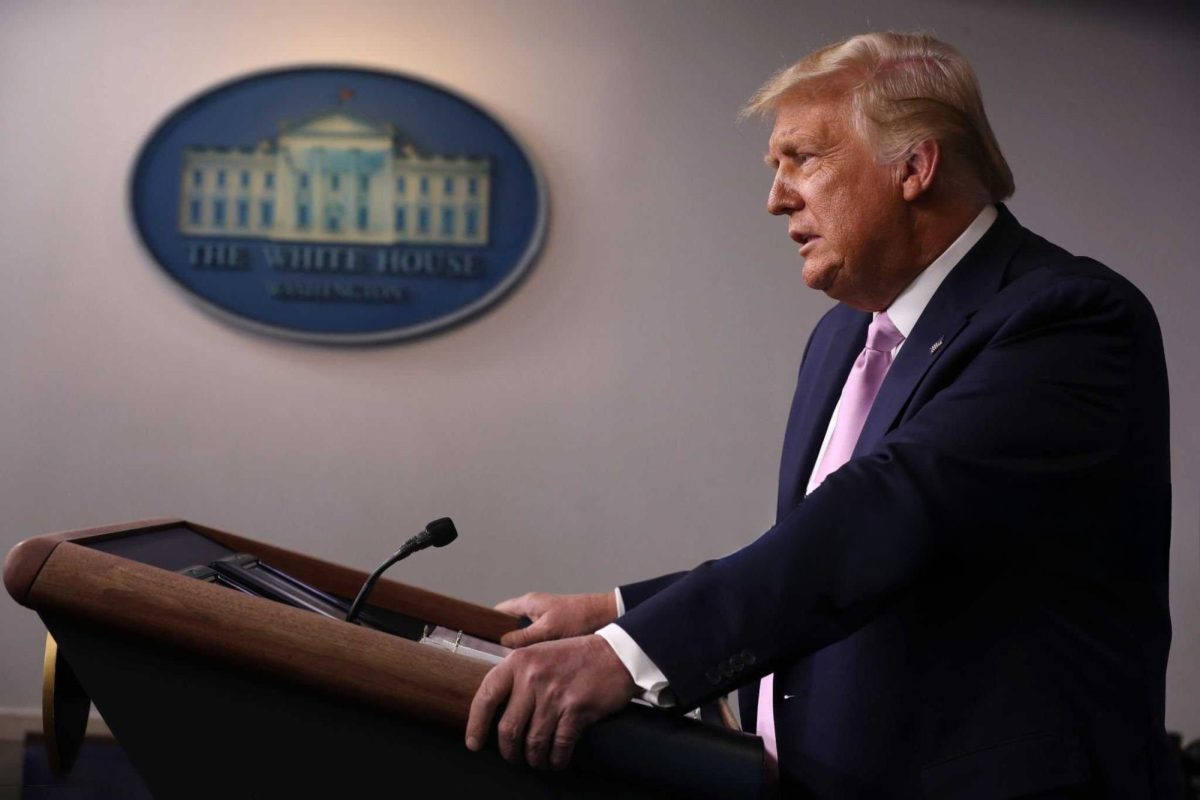
On Jan. 20, 2025, Donald Trump was sworn in for his second, non-consecutive term as President of the United States, pledging to restore the country to a “golden age.”
Trump promised to restore economic strength, tighten immigration enforcement and challenge political institutions. His first year involved testing these promises, facing battles within the branches of government and rising polarization across the country.
Over the past year, the Trump administration has prioritized stricter immigration policies, as well as economic and educational restructuring. Trump’s policies are energizing his supporters while raising concerns among opponents.
“He definitely delivered on his promises,” President of Villanova Republicans Andrew Smith said. “Especially with the immigration issue, he put in a lot of effort, emphasis and resources into immigration.”
Throughout his campaign, Trump emphasized the importance of securing the Southern border through stricter immigration policy. Some of these policies include a $13.5 billion investment in state and local enforcement of federal immigration law, alongside a $1 billion effort to divert military resources toward border enforcement.
These investments increased criminal prosecution for immigrant-related offenses and allowed for higher enforcement of immigration laws. As a result, border crossings have plummeted, and individuals held in detention centers are reaching historic highs, according to ProPublica.
However, stronger immigration enforcement has faced escalating backlash, particularly following the increased ICE presence in Minnesota. The killing of American citizens Renee Good and Alex Pretti by ICE officers sparked protests across the nation. The administration argued these measures were necessary for national security. Nevertheless, lawmakers in Congress began demanding investigations into the citizens’ deaths and defunding of ICE operations.
“You never thought that you would see that here,” President of Villanova Democrats Joey Scerbo said. “If there was an outside country that was doing the same thing, we would say that would give us justification to go and intervene.”
U.S. foreign relations have defined news regarding President Trump and the acquisition of Greenland.
Trump made claims to seize Greenland for “security reasons,” which have been denied by Greenland’s leaders. In response, Trump threatened additional tariffs against numerous European allies for opposing his plans, according to the BBC. These claims have sparked debate amongst supporters and critics surrounding the role of the United States as an expansionist or isolationist country.
Simultaneously, Trump’s tariff announcements increased the costs of essential goods and led to rising unemployment. This was followed by decreasing amounts of the budget going to health care, food assistance and clean energy. The administration’s actions led to 70 percent of Americans predicting 2026 will be a year of economic difficulties, according to Gallup.
Some Americans are trying to remain hopeful that Trump’s domestic investment will lead to further development of infrastructure and the creation of jobs.
“I think they hurt in the short term, but will benefit in the long term,” Smith said.
The Trump administration also aimed to reshape education in America. Early in his term, Trump signed an executive order calling for the dismantling of the Department of Education. However, the administration claimed the core functions of the department would be preserved, including funding for lower-income schools and students with disabilities, according to the Clery Center.
Beyond K-12 education, the administration’s efforts to restructure federal oversight have extended into higher education. Many institutions have been forced to decide between defending their independence or giving in to the federal government’s demands due to financial pressure.
Harvard University faced a lawsuit with the administration because they refused to yield to demands such as third-party audit of the viewpoints of students, faculty and staff.
Harvard also refused to diminish the power of instructors and administrators involved in activism. As a result, the administration threatened the university by withholding $2 billion in federal funding, according to NPR.
“I think that Trump going after universities is supported by a lot of actual working-class Americans because they see a lot of money going to these institutions for studying things that don’t improve their life using their taxpayer dollars,” Smith said.
Trump started his term with frequent implementation of executive orders. In his second term so far, Trump signed 221 executive orders, beating his first term total of 220 orders, according to the Pew Research Center.
These executive orders focused on an array of issues including foreign relations, immigration, defense and government operations. While the orders address a wide range of policy areas, critics argue that their sheer volume reflects a broader consolidation of executive power.
“There has been an unwillingness to place any checks on his power,” Scerbo said.
The administration’s policies have influenced Villanova’s political environment.
“I think that people that never liked Trump are the loudest, it just got louder,” Smith said.
While criticism continues, public demonstrations have become less frequent.
“There were protests here and there, but we are not seeing that now,” Scerbo said. “People are upset about the ICE raids and presence, but nobody seems to really care that much outwardly.”
Success in the 2026 midterm elections is critical for both parties. Currently, Republicans have control of the House.
“Midterm elections are very important, especially this year, because if the Democrats win at least one chamber of Congress, it would place a check on the president,” Scerbo said.
As Trump enters the second year of his term, questions surrounding executive power, congressional oversight, and the direction of the country are expected to intensify. Whether the Trump administration can reshape the nation to align with his vision will depend largely on the outcome of the midterm elections.