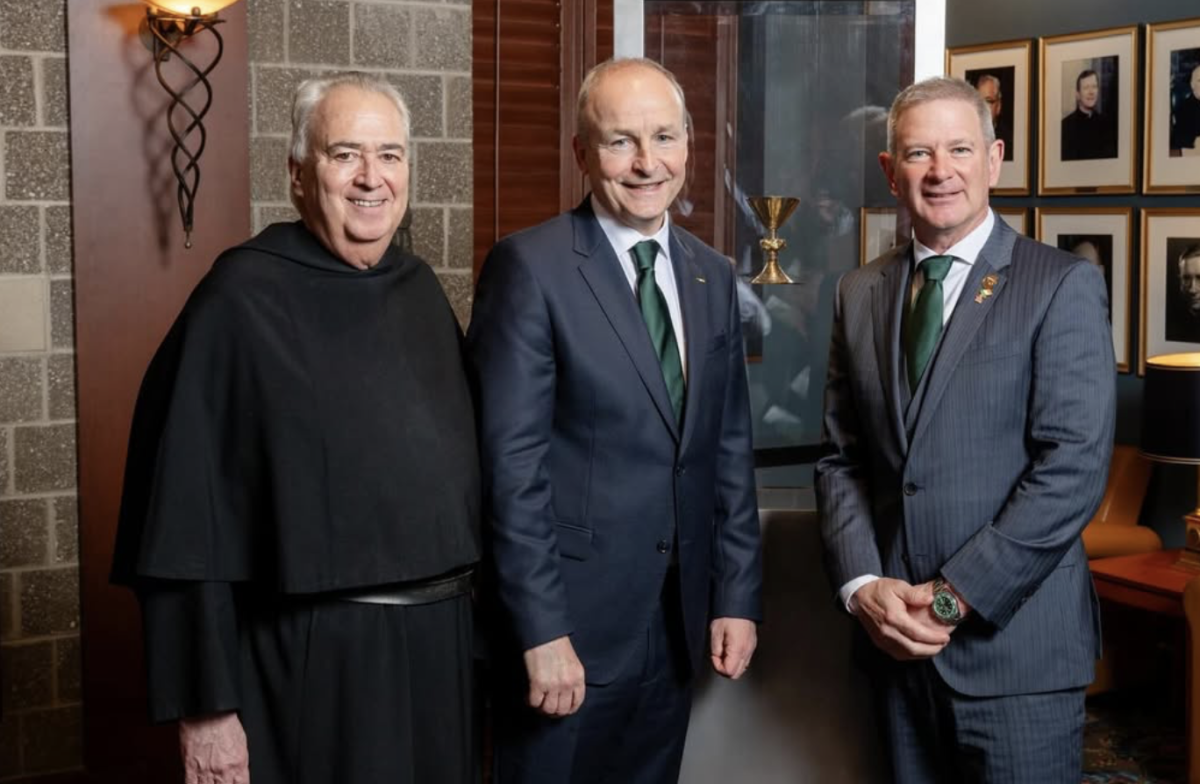
Commemorating 250 years of enduring connections between Ireland and the United States, Villanova University’s Center for Irish Studies hosted Irish Prime Minister Micheál Martin on Saturday, March 14, in an afternoon celebrating Irish American history. Prime Minister Martin was joined by Villanova faculty with deep connections to Ireland and a commitment to Irish Studies.
Villanova University Provost Patrick Maggitti delivered opening remarks, highlighting the university’s Irish roots and calling attention to Villanova’s Irish Studies program as the longest-standing of its kind in the United States. He spoke about the “Irish Pipeline,” which has recruited Irish Track and Field athletes to attend Villanova since 1948. Maggitti also recognized that Villanova alumnus Edward Walsh, who attended Saturday’s event, was recently named the United States ambassador to Ireland. Walsh, his wife and three daughters all graduated from Villanova.
Irish Prime Minister Micheál Martin then took the stage to express the vital role of universities like Villanova in supporting the Irish-American relationship. Martin outlined two key matters he wished to speak on: “the power of sport in building international connections and the 250th anniversary of the American Declaration of Independence.”
Martin emphasized the role of Irish Americans in the formation of the United States and called attention to Irish native Charles Thomson, who designed the Great Seal of the United States, which features the words “e pluribus unum,” meaning “out of many, one.” Martin asserted that the Irish people would draw on these same unifying words for generations to come.
While noting complexities and challenges within Irish American history, Martin recognized the many accomplishments that Irish immigrants have achieved in America.
“America was, is and will remain a land of opportunity,” Martin said.
The Irish Prime Minister focused on the role of sports in fostering Irish American connections.
“Sport is a transformational and unifying force,” Martin said. “It brings people together. It drives connections between our people, generates economic activity, promotes tourism and develops political relationships.”
He highlighted the accomplishments of Villanova’s Irish athletes over the years and spoke about the Irish Pipeline.
“[It] allowed hundreds of Irish athletes to pursue academic and athletic excellence here at Villanova,” Martin said.
Martin concluded that the same spirit of unity that inspired America’s founders 250 years ago continues to inspire Villanova today.
“In a world which faces monumental challenges, it should direct us to work together on a shared and exciting future, for Ireland, for our relationship with the United States of America and for the world we share,” Martin said.
Joseph Lennon, the Emily C. Riley Director of the Center for Irish Studies, proceeded to moderate a discussion panel of Villanova faculty, featuring Political Science Professor Cera Murtagh, Chair of Irish Studies Cauvery Madhavan, and Irish Studies Professor Jonathan O’Neill.
After being prompted to share her Irish immigration experience, Cera Murtagh said that while living in Philadelphia the past eight years, she has maintained connections to Ireland through her work with the Irish Studies program and taking students to study there.
“It is a privilege to be part of ongoing ties that the Prime Minister referenced,” Murtagh said.
Cauvery Madhavan described her own connection to Ireland, explaining that upon moving there, she immersed herself in Irish culture through literature, television, and conversing with the Irish.
“[Ireland is]the best place in the world for the nurturing of the creative arts,” Madhavan said.
Lennon asked panelists about Ireland’s political use of soft power, which involves a country achieving desired outcomes through appeal rather than coercion.
Jonathan O’Neill cited the Irish language as an example of soft power, exemplified today by the Irish government’s partnerships with American universities, such as Villanova, for Irish language programming.
“[It] acts as a thread that connects Ireland to the United States back a thousand years,” O’Neill said.
Murtagh highlighted Ireland’s role in the European Union.
“[Ireland is] well positioned to promote democracy and human rights in other parts of the world,” Murtagh said.
He further offered that Irish popular culture has sustained Irish American connections, as it “gives younger generations new perspectives of Irish history.”
“No country in the world has used soft power as smartly as Ireland,” Madhavan said.
Madhavan stated that Ireland uses the arts to drive its economy, exert global influence and maintain collaboration with American universities such as Villanova.
U.S. Congresswoman Mary Gay Scanlon, representative of Pennsylvania’s fifth congressional district, delivered closing remarks. She highlighted that Irish American ties preceded the formation of the United States and persist today through culture, shared values and bonds like Villanova’s Irish Pipeline of athletes.
“[America can] learn from Ireland’s values-based foreign policy and its commitment to diplomacy, peacekeeping and humanitarian efforts,” Scanlon said.
Scanlon left the audience with a call to continue collectively working towards a prosperous future for Ireland and America.
The Irish Prime Minister’s visit to Villanova demonstrated the university’s powerful connection to Ireland and the Center for Irish Studies’ commitment to promoting scholarship in this area.