
On Saturday, Dec. 6, fans slowly trickled into the half-empty bottom bowl of Xfinity Mobile Arena to watch Villanova men’s basketball take on the University of Pennsylvania in the Big 5 Classic championship game.
Villanova students stretched from behind the basket all the way to the main concourse on its side. It was certainly the biggest crowd of the six teams — Villanova, Temple, St. Joe’s, Penn, La Salle and Drexel — that make up the tournament.
The occasional rollouts that have become an iconic part of the Big 5 lacked any substance, creativity or originality.
“It clearly isn’t 2016 anymore,” one Penn rollout read.
What happened in 2018…?
The Big 5 no longer looks or feels anything like it once did.
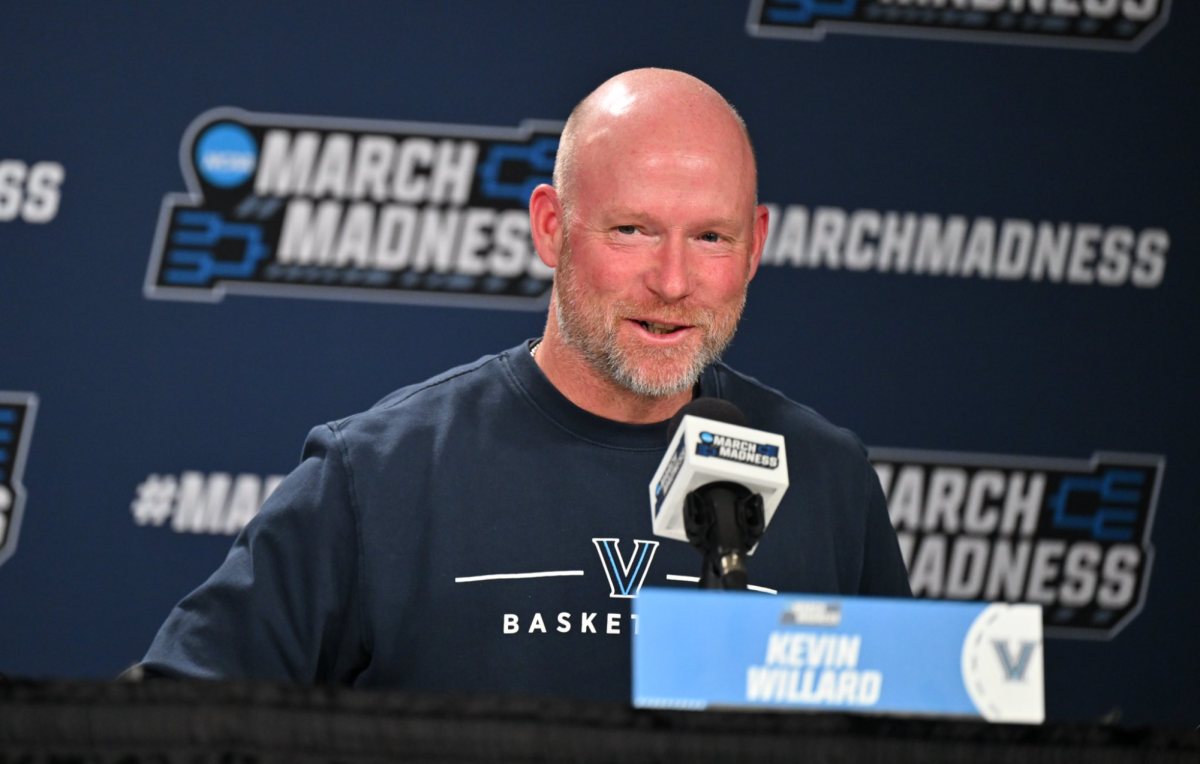
While Villanova did its part to keep the Big 5 alive this past weekend, it still has plenty of room to do more to sustain the Philadelphia college basketball rivalry. Villanova head coach Kevin Willard briefly expressed his thoughts on the state of the Big 5 in September, and while he said it was not going to go away, he did not necessarily praise it either. The biggest issue for Willard was financial.
“When you spend $6 million on a roster, revenue is really important,” Willard said on “The Sideline” with Andy Katz when asked about the Big 5.
Willard’s worries are legitimate. The Name, Image and Likeness (NIL) era has changed the college landscape for better or worse. However, Villanova needs to work on reviving the Big 5 to a place where fans still reminisce, rather than moving away from it.
Willard’s thoughts on the Big 5 do not differ too much from former Villanova coach Rollie Massimino. At the start of the 1986-87 season, Massimino notably turned the Big 5 City Series on its head by moving the team’s games from the Palestra to campus on the Main Line.
It was just months after Villanova captured its first NCAA national title, and that was not a coincidence. It made the Big 5 a shell of its former self.
Before Villanova raised the trophy in 1985, the Big 5 was a vital part of the program’s schedule. For the 30 years leading up to the title, the Wildcats benefited greatly from the four non-conference games against their Big 5 opponents.
Once the round-robin City Series came to an end in 1991, Villanova played just two Big 5 opponents from 1991 through 1999.
While Villanova has received criticism for being the program that wants to kill the Big 5 for good, it is currently the only program keeping it alive. Since the new Big 5 Classic triple-header round-robin tournament was introduced in 2023, attendance has declined each year. In 2023, 15,215 fans filled the then-named Wells Fargo Center. The following year dropped to 14,108, and this year plummeted to 10,361.
It goes to show the current format is not succeeding as expected. Not that many students want to travel to South Philly to watch sub-par basketball, especially since most of them are not die-hard fans in the first place. Most students just want to have a good time and watch their team win by as much as possible.
For years, the Palestra on the University of Pennsylvania’s campus in University City was consistently filled with 8,700 fans from across the five basketball programs.
The Big 5 has been a staple of Philadelphia’s basketball culture since its creation in 1955. Every season, five teams would face off against each Big 5 opponent to decide who claimed the Big 5 title. Then in 2023, the format changed to a six-team round robin tournament with the addition of Drexel University, and the location shifted to the Wells Fargo Center (now known as the Xfinity Mobile Arena).
This season, the Big 5 reshuffled its pods, separating Villanova and St. Joe’s. It was to set up the possibility of the “Holy War” being played in the championship game, but instead, it ended a 30-year streak of the two programs playing each other.
That is why the Big 5 needs a solution to its current format. The six teams would be better off playing their games back in an arena like the Palestra, where they could easily pack in two student sections and fans. Alternatively, each team could host in their home arenas, which they currently do leading up to the triple-header. That would also help with increasing ticket prices. Bottom-bowl seats at the Xfinity Mobile Arena for this year’s Big 5 Classic ran upwards of $100 in some locations. It has made the tournament unattractive to many fans.
Addressing financial concerns would be the only way for the Big 5 to continue. Villanova sometimes spends upwards of six figures to host non-conference opponents, preparing the team for difficult Big East conference matchups. Instead, that money could be saved by hosting a Big 5 opponent in the Finneran Pavilion.
Philadelphia is the only city to have five college basketball teams to represent it in a tournament. It is one of its kind. While Villanova might have done the most “harm” to the Big 5 in the past five decades, it currently has the most power to shape it into a rejuvenated tournament and rivalry across the city.