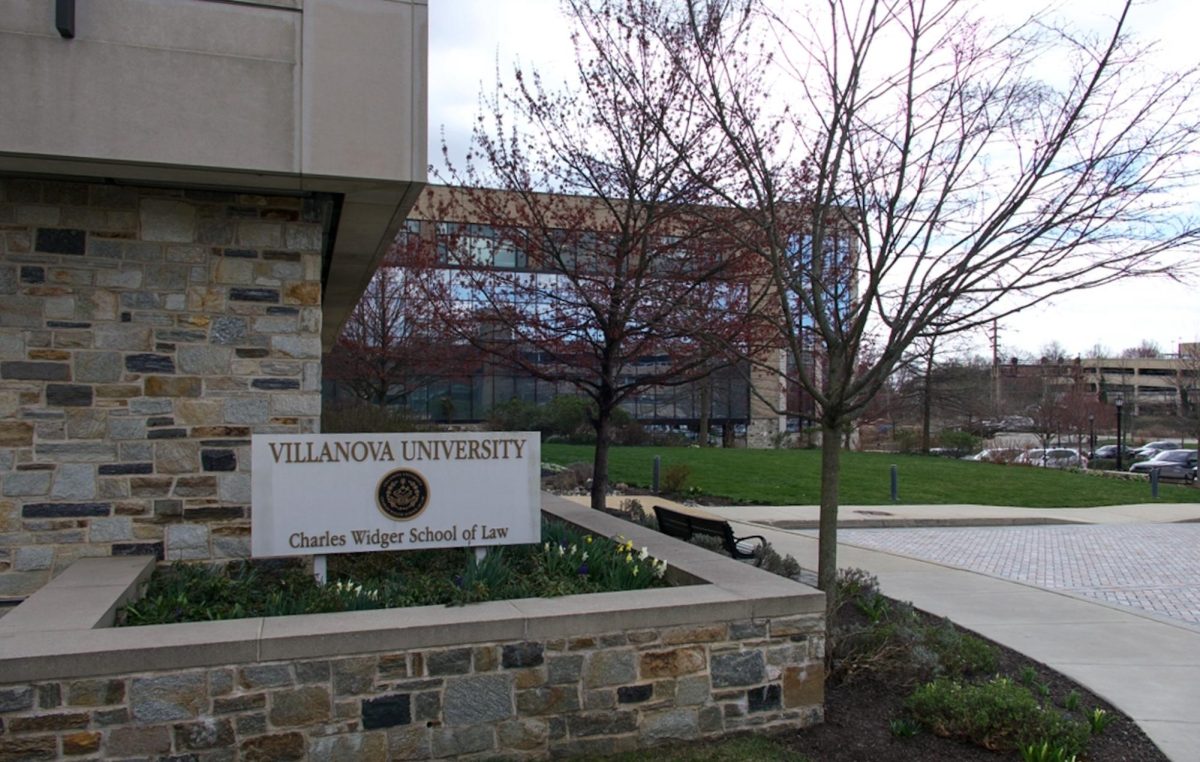
On Thursday, Nov. 13, supported by the Office of Mission and Ministry, Villanovans from both the Augustinian Institute and Mother Cabrini Institute on Immigration gathered together in the commons of the Charles Widger School of Law to celebrate St. Augustine’s birthday and Mother Cabrini’s Feast Day.
The panel, composed of speakers from a range of knowledge pertaining to migration, centered its discussion around what the Augustinian tradition and Mother Cabrini can teach individuals about immigration.
The event began with a warm welcome from moderator Colleen Mitchell, Associate Director of Outreach for the Augustinian Institute at Villanova University, and was followed by opening remarks from the School of Law’s Dean, Mark C. Alexander, J.D., and Congresswoman Mary Gay Scanlon (D-PA).
Congresswoman Scanlon addressed the political tension surrounding immigration, especially nowadays, and contrasted today’s environment with the message Mother Cabrini preached. Scanlon described the climate as “an active attempt to scare people for political ends,” describing the situation as “unwarranted.”
“It is important that we push back against this conflation and demonization of immigrants,” Scanlon said. “As well as the tactics that are being used.”
Affirming the inherent dignity of every person, regardless of their immigration status, Scanlon transitioned to the importance of constitutionality.
“[The Trump] administration is pushing the idea that if you are an immigrant you don’t have due process rights,” Scanlon said. “Due process is important for all of us, if anyone doesn’t have it, then all of us don’t have it.”
Scanlon concluded her statement by expressing how “heartening [it was] to see the merger between the faith and legal communities” in addressing the issue of immigration.
Handing the microphone over to Dr. Sean Hannan, Assistant Professor in the Humanities Department at MacEwan University, Hannan began his remarks with a brief synopsis of the roots of the word migration.
The Latin word Peregrinatio can be translated as pilgrimage or migration. Hannan says that when “[he] makes the decision to translate peregrination as immigration or migrancy, [he] [tries] to shift the discussion away from migrancy itself and towards what St. Augustine would say about migrants.”
Hannan mentioned that St. Augustine likely grappled with the same questions we face today.
“St. Augustine believed that we are all migrants in search of a homeland, but it’s more than a metaphor,” Hannan said. “We should be helping our neighbors from abroad.”
Building on Hannan’s discussion of St. Augustine, Dr. Joseph Lennon, CLAS Associate Dean, Emily C. Riley Director of Irish Studies at Villanova University, continued by explaining that St. Augustine’s church was “a church for immigrants by immigrants.”
Lennon discussed Irish roots of immigration in Philadelphia, comparing the hostile and discriminatory environment of 19th century Philly with the current political climate.
Lennon included a variety of political cartoons, which displayed the period’s dehumanizing rhetoric directed towards Irish immigrants. Despite the discrimination that toiled society at the time, Lennon concluded with an emphasis on the welcoming spirits of the Augustinians, encouraging audience members to live the same way.
Sister Christine Marie Baltas, MSC Campus Ministry, Cabrini University, followed Lennon. Her speech was in the form of an engaging and vividly-detailed story of Mother Cabrini’s life from her early girlhood to her final years.
Baltas emphasized Mother Cabrini’s impact on immigrant communities far-and-wide, making special note of the work she did for Italian migrants in America, which included establishing a number of hospitals and orphanages to provide healthcare and social services to the needy.
The panel concluded with remarks from Professor Michele R. Pistone Professor of Law, Director of the Mother Cabrini Institute on Immigration at Villanova University.
Pistone described how St. Augustine exemplified Veritas, Pope Leo XIV embodied Unitas, and Mother Cabrini was a walking definition of Caritas. She also excitedly shared news about the new and upcoming Cabrini Institute, which recently hosted its first “Refugees & Migrants in Our Common Home” conference of about 250 people with a special appearance from Pope Leo XIV in Rome, Italy.
Pistone talked about the four areas of action and impact which the Institute hopes to employ as a means of serving immigrants and addressing the topic of migration: teaching, research, advocacy and service.
By focusing on and developing the mentioned pillars, Pistone and the Cabrini Institute believe that they will successfully and impactfully help others better understand immigration and, in turn, foster a more empathetic environment.
The panel concluded with a brief question-and-answer session between audience members and panelists, and a light reception in celebration of both St. Augustine’s birthday and Mother Cabrini’s feast day.